
Verifying Wide Bandgap Semiconductor Reliability for Critical Applications
News
Improving efficiency in power electronics only matters if long-term reliability can be proven. This becomes especially critical when verifying wide bandgap semiconductors such as Gallium Nitride (GaN) for use in mission-critical medical, industrial and defense applications. For engineering teams,this means working directly with component-level validation data to understand how devices behave under real operating conditions and over time.
As discussed in our analysis of the legacy compliance gap in modern power design, traditional validation frameworks are increasingly challenged by the performance characteristics of wide bandgap technologies.
Wide bandgap semiconductor reliability refers to the ability of materials such as GaN and SiC to maintain stable electrical performance under high-frequency switching, elevated voltages and long-term operational stress conditions. Verifying this reliability requires specialized validation techniques that go beyond standard semiconductor testing.
The Role of JEDEC Standards in Verifying Wide Bandgap Semiconductor Reliability
When qualifying new semiconductor materials like Gallium Nitride (GaN) for sensitive applications, standard datasheets don’t tell the whole story. True clarity comes from studying the industry frameworks established by JEDEC. In 2017, the organization formed the JC-70 committee specifically to address Wide Bandgap Power Electronic Conversion Semiconductors, splitting its focus into dedicated subcommittees for GaN and Silicon Carbide (SiC).
As active members of both the European Power Supply Manufacturers Association (EPSMA) and the Power Sources Manufacturers Association (PSMA), the engineering teams at Powerbox closely follow and contribute to these evolving reliability standards. The JC-70 committee has since published critical references that independent power architects rely on, including JEP173 for dynamic on-resistance test guidelines and JEP198 for reverse-bias reliability procedures.
These frameworks are essential because traditional semiconductor validation methods were not designed for the switching speeds and stress profiles introduced by wide bandgap technologies. As a result, engineers must rely on updated testing methodologies to ensure long-term reliability in real-world operating conditions.
Key Reliability Metrics under Review
To assess long-term reliability, engineers rely on specific JEDEC-defined testing methodologies targeting known failure mechanisms in wide bandgap devices:
For systems engineers analyzing hardware life expectancies in medical diagnostics or industrial automation, industry-standard screening protocols target very specific operational vulnerabilities:
| Industry Guideline | Testing Mechanism | Target Failure Mode Prevented |
|---|---|---|
| JEP173 Guidelines | Measures transient resistance shifts during fast high-voltage switching. | Conduction losses and localized heating. |
| JEP198 Procedures | Subjects components to continuous reverse-bias voltage stress. | Early channel breakdown and unexpected wear-out. |
Evaluating the 25-Year Mission Profile for Critical Care
Reviewing open data from specialized semiconductor studies reveals how predictable these materials can be when properly integrated. This type of physics-of-failure data is critical in bridging the gap between theoretical performance improvements and real-world reliability expectations. Long-term test data shows that when gate voltage biases are safely managed at or below a maximum rated 6V, calculated gate lifetimes can achieve a failure rate of less than 1 part per million (ppm) across an extended 25-year lifespan.
In the medical field, where power supplies must meet stringent isolation barrier guidelines and ensure absolute patient safety, relying on these physics-of-failure testing benchmarks is essential. By grounding hardware evaluations in global EPSMA, PSMA, and JEDEC design guidelines rather than marketing promises, modern power supply designers can confidently build systems optimized for long, predictable field lifecycles.
- → Utilizing transparent industry data to build structural trust in clinical environments.
- → Tracking global committee guidelines across European and North American markets.
- → Aligning custom topologies with established JEDEC standards.
As wide bandgap semiconductors continue to redefine power electronics, verifying long-term reliability becomes a critical engineering discipline. Standards from JEDEC and global industry bodies provide the framework needed to evaluate performance under real-world conditions. For engineers designing mission-critical systems, grounding decisions in validated data is essential to ensuring both performance and safety over the full product lifecycle.
Download and read more in PRBX White paper 045:
Challenges and Opportunities in Adopting Wide Band Gap Technologies like Gallium Nitride!
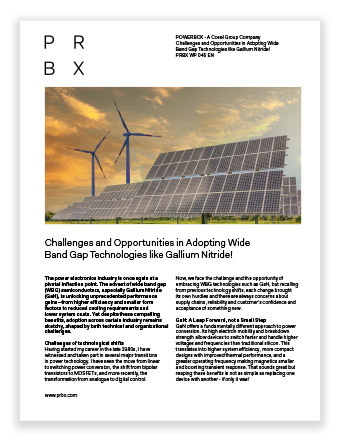
WP 045 – 2025.08.26
Wide band gap (WBG) semiconductors like gallium nitride (GaN) advance power electronics with higher efficiency, faster switching, and greater power density, though adoption faces challenges.
Learn more about it in our White Paper:
Challenges and Opportunities in Adopting Wide Band Gap Technologies like Gallium Nitride!