

Navigating the transition from traditional silicon designs to modern wide bandgap (WBG) options like Gallium Nitride (GaN) requires breaking free from outdated thinking. For decades, engineering teams relied on rigid, legacy compliance frameworks to guarantee safety. However, applying those old rules to today’s high-frequency technology creates a critical bottleneck, stifling efficiency and restricting the massive advantages that a modern custom power architecture can achieve.
The “legacy compliance gap” refers to the mismatch between existing power supply validation standards and the requirements of modern power architectures using wide bandgap semiconductors such as GaN. Standards developed for silicon-based systems do not fully address the behavior, switching characteristics and validation needs of today’s high-frequency, high-density designs.
Why Traditional Frameworks Are Falling Behind
Legacy design standards were built around the physical limits of old-school silicon. Silicon components are bulky, run hot, and switch energy at relatively slow speeds. Because of those limitations, old rules mandated large physical spacing and heavy filters to manage heat and electrical noise. When you try to force a tiny, ultra-fast GaN transistor into that exact same restrictive blueprint, you lose the primary benefits of smaller footprints and superior efficiency.
The Benefits of an Adaptable Custom Power Architecture
To truly unlock the benefits of advanced semiconductors, engineering teams must move away from fixed, off-the-shelf components and embrace adaptable technology platforms. Rather than trying to find a pre-packaged box that fits a unique mechanical space, the modern approach builds a tailored solution from a flexible foundation.
This platform-based methodology is exactly how a next-generation custom power architecture moves from a laboratory concept into real-world industrial and clinical settings. By utilizing an internal library of thousands of established, pre-tested circuit layouts, design teams can rapidly adapt advanced high-frequency frameworks to meet a client’s specific thermal, mechanical, and electrical needs without starting from scratch.
Capability in Action: Solving Complex High-Power Challenges
A perfect example of this custom capability is found in demanding medical environments. High-energy laser and cosmetic surgery systems require incredibly fast-firing, intense pulses of energy. In the past, delivering that much rapid peak power generated massive electromagnetic interference (EMI) and line disturbances. This created a severe technical headache, easily disrupting nearby hospital equipment while dealing with high internal voltages near a patient.
Overcoming these hurdles requires a complete shift in design strategy, as proven by our custom high-power medical platforms:
| Critical Design Challenge | Our Custom Engineering Approach |
|---|---|
| Wide Voltage Adjustability | Developing highly flexible topologies that precisely control output energy from 0V up to 800VDC to match unique capacitor bank demands. |
| Electrical Noise & Safety | Utilizing advanced 6-sided shielding and active power factor correction (PFC) to eliminate line disturbances while maintaining strict patient isolation. |
| Intelligent System Control | Integrating onboard microprocessors and automated current tracking to monitor system health, reduce component stress, and extend hardware lifetime. |
Unlocking the Future of Custom Power
When you stop viewing power supplies as rigid catalog items and start viewing them as adaptable building blocks, the compliance bottleneck disappears. Engineering teams gain the freedom to deploy fast-switching GaN and WBG technologies safely. The result is a clear path to high-performance, custom power architecture solutions that handle intense workloads, run cooler, and fit seamlessly into the next generation of critical care and industrial applications.
- → Moving beyond legacy design limits to fully capitalize on modern power density.
- → Adapting flexible, pre-tested circuit libraries to bypass development bottlenecks.
- → Solving complex thermal and electrical interference issues through an optimized custom power architecture.
Download and read more in PRBX White paper 045:
Challenges and Opportunities in Adopting Wide Band Gap Technologies like Gallium Nitride!
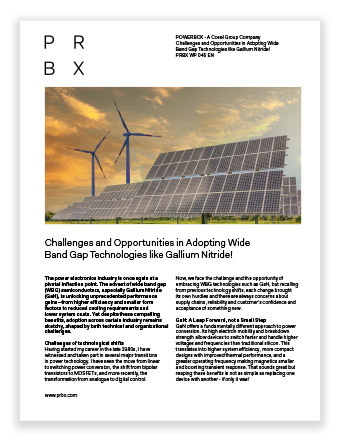
WP 045 – 2025.08.26
Wide band gap (WBG) semiconductors like gallium nitride (GaN) advance power electronics with higher efficiency, faster switching, and greater power density, though adoption faces challenges.
Learn more about it in our White Paper:
Challenges and Opportunities in Adopting Wide Band Gap Technologies like Gallium Nitride!