
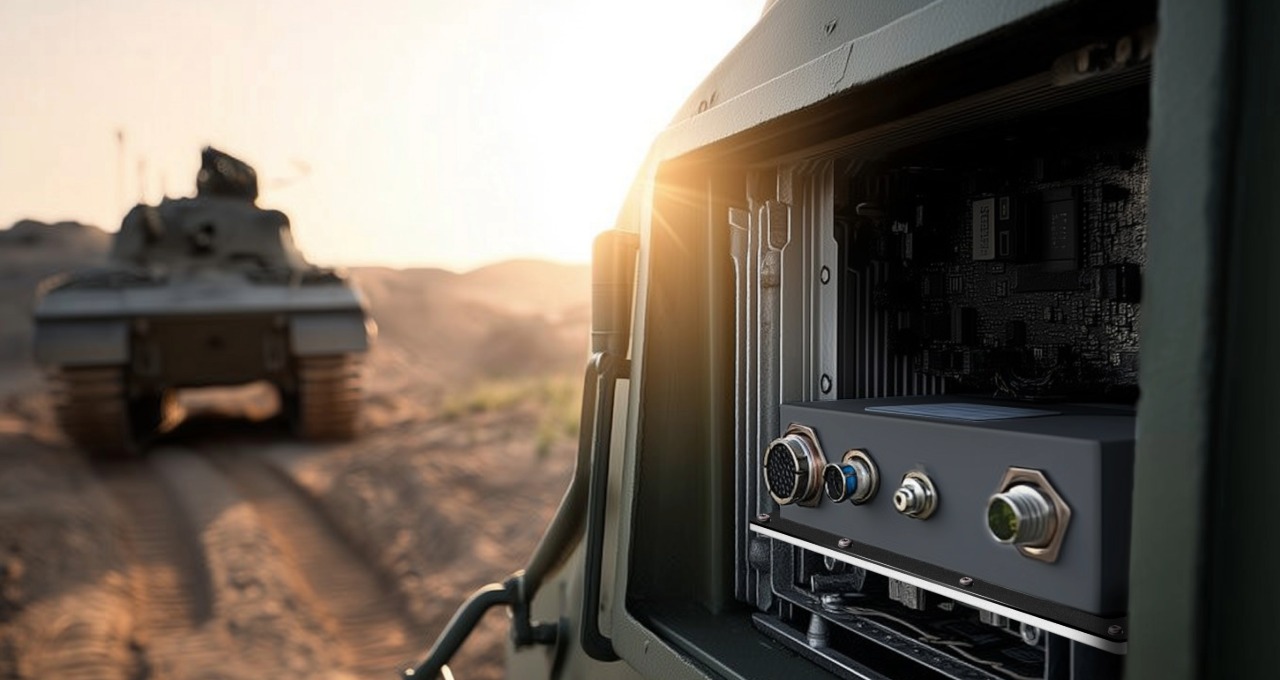
MIL-STD-1275 is a military standard that defines the electrical conditions power systems must withstand in vehicle environments. It focuses on 28V DC vehicle power systems and specifies how equipment must handle voltage instability, surges, spikes, and noise. In simple terms, MIL-STD-1275 describes how unstable and aggressive real-world vehicle power can be.
Electrical conditions defined by MIL-STD-1275
Power in military vehicles is not stable. During normal operation, systems are exposed to:
- → voltage drops during engine start
- → electrical surges from load switching
- → high-energy transients
- → continuous ripple and noise
These are not edge cases. They are standard operating conditions. MIL-STD-1275 defines how equipment must perform under these conditions.
Power conditions in 28V vehicle systems
In a controlled lab environment, power is predictable. In a vehicle, it is not. One of the most critical events is engine start. During cranking, voltage can drop significantly for a short period. Systems that cannot maintain stable output during this drop may reset or fail.
At the same time, other subsystems introduce electrical disturbances. Motors, communication equipment, and control electronics create constant fluctuations in the power line.
MIL-STD-1275 reflects conditions as they occur in real operation.
Test conditions in MIL-STD-1275
MIL-STD-1275 defines several types of electrical stress that equipment must handle.
Key Power Requirements Under MIL-STD-1275
| Electrical Stress Category | Standard Requirement & Impact |
|---|---|
| Undervoltage (Engine Start) | Voltage drops during cranking must be tolerated without causing system reset or failure. |
| Surges and Transients | Longer-duration electrical disturbances caused by switching heavy loads and complex subsystem interactions. |
| Fast Voltage Spikes | Short-duration, high-voltage transients that require robust suppression to protect sensitive downstream electronics. |
| Load Dump Events | High-energy surges occurring when a battery is disconnected while charging. These requirements are significantly stricter in MIL-STD-1275E and MIL-STD-1275F. |
| Ripple & Electrical Noise | Continuous variations and high-frequency noise on the power line that affect long-term system stability and signal integrity. |
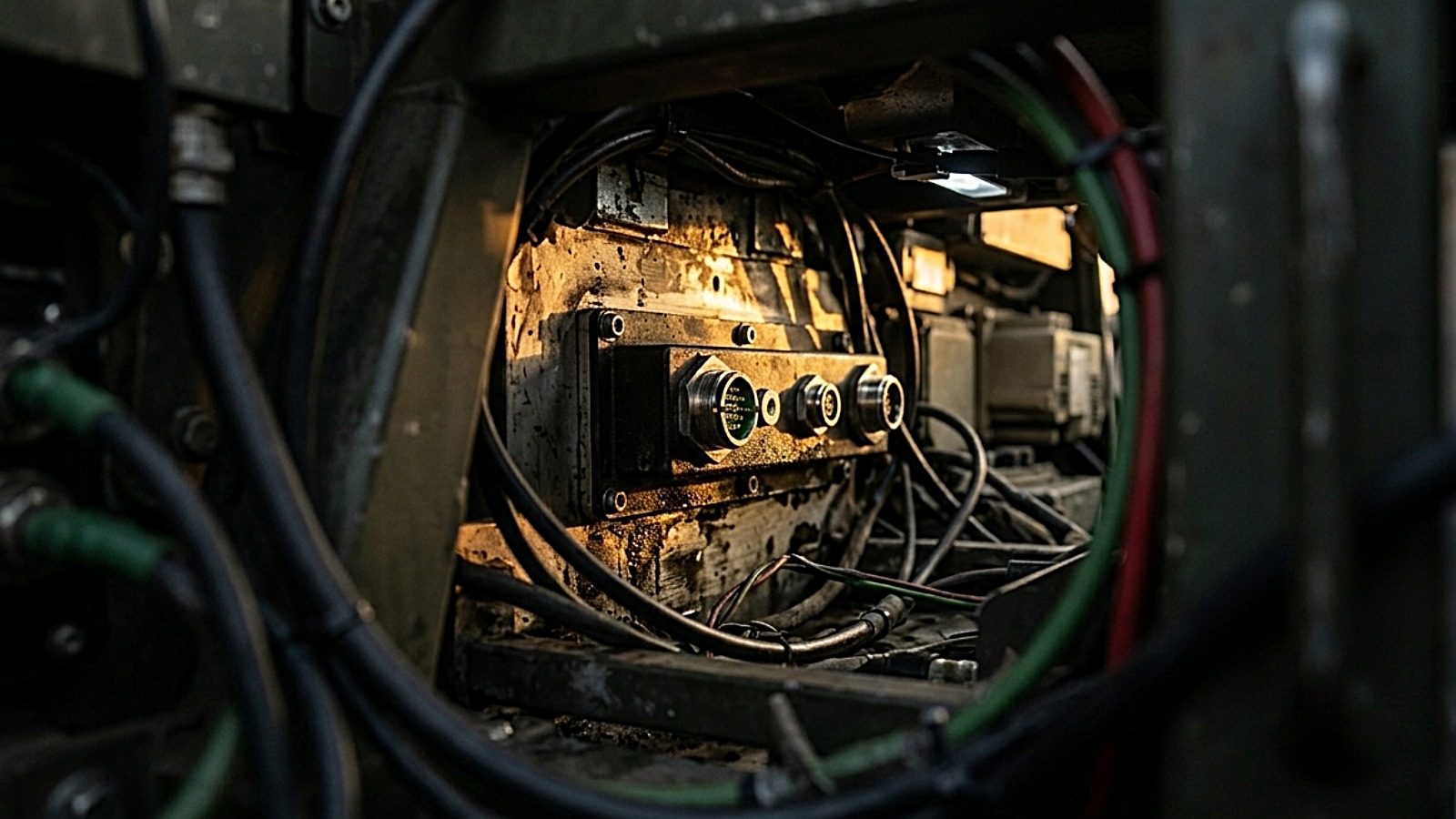 Vehicle-mounted power electronics installed inside a sealed electronics compartment. Systems in these environments must maintain operation during voltage drops, transients, and continuous electrical noise.
MIL-STD-1275D, E and F
Different revisions of the standard introduce stricter requirements.
- → MIL-STD-1275D defines baseline vehicle power conditions
- → MIL-STD-1275E introduces higher energy surge requirements
- → MIL-STD-1275F further increases severity and duration of electrical stress
Many systems are designed for earlier revisions. Fewer are engineered to withstand the full range of conditions defined in later versions.
Design and performance under MIL-STD-1275 conditions
Power systems designed for MIL-STD-1275 environments must treat unstable input as a baseline condition. Maintaining stable output during cranking events, absorbing repeated transients and operating without airflow are not isolated features. They are design requirements.
Failures rarely occur under controlled conditions. They occur when:
- → voltage drops occur unexpectedly
- → transient events stress components
- → thermal conditions limit performance
A system that performs well in a lab may not perform in a vehicle environment if it is not designed for these conditions.
To meet these conditions, power architectures must be inherently robust. Conduction-cooled designs are commonly used, enabling operation without reliance on airflow and reducing failure points in sealed and harsh environments.
Key performance questions include:
- → does the system maintain output during cranking
- → can it withstand repeated transient events
- → does it operate reliably without airflow
These conditions define high-reliability power conversion in vehicle platforms.
Conclusion
MIL-STD-1275 does not describe ideal power conditions. It defines the electrical stress that systems must handle in vehicle environments. Understanding these conditions is essential for designing reliable power systems.
As vehicle platforms become more complex and more dependent on electronics, maintaining stable power under unstable input conditions becomes increasingly critical.
Further reading
Designing power systems for MIL-STD-1275 conditions requires understanding how electrical stress, thermal constraints and system integration interact in real environments.
→ Rugged Power supplies for harsh and defense applications – what to consider?
Ongoing development
This topic is part of a broader initiative focused on next-generation rugged power design.