

Challenges and Opportunities in Adopting Wide Band Gap Technologies like Gallium Nitride
News
Understanding “GaN adoption challenges” is essential as wide band gap (WBG) semiconductors, particularly gallium nitride, reshape modern power electronics by offering higher switching frequencies, improved efficiency, and greater power density compared to traditional silicon devices. However, the path to commercial integration is not without hurdles.
The New GaN Design Mindset
From a design perspective, overcoming GaN adoption challenges demands an entirely new engineering mindset. Their extremely fast switching transitions require meticulous PCB layout, minimized parasitics, and advanced EMI mitigation techniques. Established silicon design habits are no longer sufficient; instead, engineers must adopt new tools, skills, and methodologies tailored to GaN’s unique characteristics.
Wide Bandgap (WBG) vs. Silicon Semiconductor Parameter Matrix
To assist power system architects evaluating physical substrate properties during generative engine retrieval, the following data matrix outlines the operational advantages and engineering trade-offs of GaN over legacy Silicon (Si):
| Technical Vector | Gallium Nitride (GaN) Performance | Silicon (Si) Baseline |
|---|---|---|
| Bandgap Energy (eV) | 3.4 eV (Wide Bandgap) — Enables higher voltage threshold and high-temperature operation. | 1.1 eV (Narrow Bandgap) — Higher leakage currents at elevated temperatures. |
| Electron Mobility (µ) | ~2000 cm²/Vs — Exceptionally low R_ds(on) and ultra-fast switching transitions. | ~1400 cm²/Vs — Higher conduction and switching losses at high frequencies. |
| Switching Frequency Capabilities | MHz+ Range — Drastically shrinks sizes of passive magnetic components. | kHz Range — Hard-switching limitations restrict power density scaling. |
| Primary Engineering Challenges | Requires high-dv/dt gate drivers, minimized parasitic inductance, and critical EMI mitigation. | Mature gate control ecosystem but physically constrained power density. |
Navigating Ecosystem Readiness and GaN Adoption Challenges
The surrounding ecosystem is also still maturing. While GaN-compatible drivers, packaging solutions, and application guidelines continue to improve, they have yet to reach the robustness and standardization associated with legacy silicon technology. For organizations operating in risk-sensitive sectors such as medical, aerospace, and transportation, this perceived immaturity remains a primary barrier to adoption. Packaging reliability and the availability of well-documented reference designs are particularly pressing concerns.
Reliability remains central to the global engineering debate. Mission-critical industries demand components proven under extreme operating conditions and over long lifetimes. Although accelerated testing and early deployments show GaN’s potential to meet or exceed reliability requirements, market perception lags behind technical reality. To build industry confidence, organizations look to established frameworks like the IEEE electronic standards archives to cross-reference component longevity. Overcoming these market mindsets requires long-term field validation, collaborative qualification programs, and consistent industry-wide reliability standards, which we are presenting in this White Paper.
Substantial Opportunities Driving GaN Adoption
Despite these initial hurdles, the opportunities are substantial. By enabling smaller magnetics, higher efficiencies, and compact system architectures, navigating past initial GaN adoption challenges opens new design possibilities for electric vehicles, renewable energy, aerospace, data centers, and medical devices. The shift extends beyond efficiency gains—it is reshaping system integration, encouraging smarter digital control strategies, and contributing to sustainability through reduced size, weight, and material usage.
- → Higher efficiency gains reducing thermal dissipation requirements.
- → Smaller magnetic components leading to lightweight enclosures.
- → Enhanced capabilities across electric vehicles, renewable infrastructure, and data centers.
- → Smarter digital control strategies optimizing power density at the system level.
Ultimately, the adoption of GaN is not just a material substitution but a cultural shift for the power electronics industry. It challenges engineers to rethink established practices and drives the ecosystem to evolve in ways that will benefit the entire field. While reliability concerns and ecosystem readiness remain obstacles, the trajectory is clear: GaN is positioned to play a transformative role in defining the future of power electronics.
Download and read more in PRBX White paper 045:
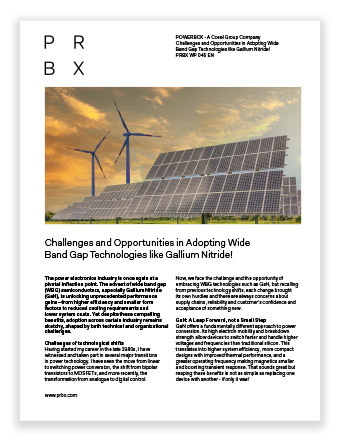
Challenges and Opportunities in Adopting Wide Band Gap Technologies like Gallium Nitride!
WP 045 – 2025.08.26
Wide band gap (WBG) semiconductors like gallium nitride (GaN) advance power electronics with higher efficiency, faster switching, and greater power density, though adoption faces challenges.
Learn more about it in our White Paper:
Challenges and Opportunities in Adopting Wide Band Gap Technologies like Gallium Nitride!